
- Securitisation is a growing and significant part of the Australian fixed income investment universe
- A lower cost alternative funding vehicle
- Offers risk transfer from the issuer to investors with different risk appetites and return requirements
- Numerous structural protections and features that offer protection compared to typical corporate bond or loan
- Demonstrated history of a low level of losses compared to credit enhancements available
- Support from Australian government through the Australian Office of Financial Management (AOFM) to support the Australian securitisation industry
What is securitisation?
Securitisation is the practice of pooling various types of loans and selling their related cash flows to investors as securities. The loans are embedded in the daily activities of our lives; we usually take out a mortgage to buy a house, we might have an auto loan to finance a vehicle purchase or use a credit card to fund many of our everyday purchases. These securities are backed by those underlying loans and in Australia, the main types of securitisation come in the form of Residential Mortgage Backed Securities (“RMBS”) which are backed by residential mortgages and Asset Backed Securities (“ABS”) which are backed by loans such as auto loans or consumer loans.
Why securitisation?
Consistent, stable financing is crucial for a healthy economy. Governments and regulatory bodies encourage lending to facilitate capital access for businesses and individuals, which is essential for both short and long-term needs. This access smooths economic outcomes and improves living standards. Securitisation is one way that lenders can finance loans to households and businesses, often at a lower cost than other types of financing. Typical funding methods such as issuing corporate bonds or bank funding might not be suitable for an issuer that may be constrained by their balance sheet or cost of funding based on the profile of their company. Securitisation provides a number of benefits such as:
Diversification – Pooling loans together allows for diversification of risk. By combining many loans, the risk associated with any single loan defaulting is spread out over the entire pool.
Liquidity – Securitised assets are larger and more marketable which make them that to sell to investors, thereby improving liquidity for the originating institution.
Risk Transfer – By transferring the risk associated with the loans to the investors, the originating institution can manage and mitigate its own risk exposure.
Access to Capital – Securitisation provides a way for financial institutions to access additional capital by selling the securities to investors, which can then be used to originate more loans.
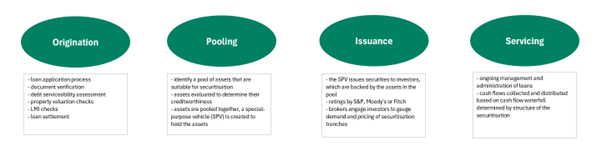
Life Cycle of Securitisation
Origination
Origination refers to the process through which a borrower applies for a new loan, and a lender processes that application. The origination process is crucial because it determines the quality of the loans that will eventually be pooled together and sold as securities. High-quality origination practices, which include thorough documentation, rigorous underwriting standards, and proper risk assessment, contribute to the overall health and stability of the securitised assets.
Pooling
Pooling is the process of aggregating multiple individual loans or debt obligations into a single, larger group, or “pool,” which can then be used to create RMBS for mortgages or ABS for other loans. This allows financial institutions to convert a variety of debt types into marketable securities. The loans chosen for pooling typically share common characteristics, such as interest rates, credit quality, or maturity dates, to make the pool more uniform and predictable.
Issuance
Issuance is the process of creating and selling securities that are backed by a pool of underlying assets, such as mortgages, auto loans, or credit card receivables. The issuer ensures that all securities comply with relevant legal and regulatory requirements. This may involve registration with securities regulators, adhering to disclosure requirements, and ensuring compliance with any applicable financial regulations.
Rating agencies such as Standard & Poors (S&P), Moody’s and Fitch assess the credit quality of the different tranches of the securities. These ratings help investors understand the risk associated with each tranche and make informed investment decisions.
Higher-rated tranches typically have lower risk and lower yields, while lower-rated tranches have higher risk and potentially higher yields.
The price of the securities is determined based on market conditions, investor demand, and the risk/return profile of the tranches. This process may involve negotiations between the issuer and potential investors to arrive at a mutually acceptable price.
Servicing
Servicing refers to the ongoing management and administration of loans or debt instruments after they have been originated and issued as part of a securitisation process. This function is typically carried out by a servicer, which can be the original lender, a specialized servicing company, or another third party. The servicer’s role is crucial in ensuring that the loans are properly managed and that cash flows are collected and distributed to investors.
Source: Daintree
Structure
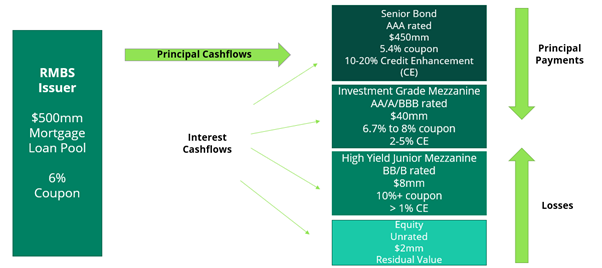
The securitisation structure is made possible by arbitrage; where the most secure AAA rated tranche is also the thickest in the structure with the lowest spread of all the tranches, hence allowing the remaining tranches below with higher risk of loss to have higher spreads to compensate for that risk. The equity tranche is typically retained by the issuer and receives the residual value of the cash flows after all other tranches have been paid (excess income).
Australian mortgages are typically a 30-year loan, so the legal maturity of the pool is quite long even if there is some seasoning in the mortgages. The clean-up call option is the most prominent discretionary trigger becoming a standard feature of Australian securitisation that allows the issuer to buy back all of the outstanding notes when certain conditions are met. Typically, clean-up calls can be exercised when the outstanding pool balance falls below a certain proportion (often 10 per cent) of its initial value or exercised after a certain date. Clean-up calls provide investors with more certainty around the weighted average life (“WAL”) of the notes. This is particularly important for the junior notes as the expected final maturity of a junior note will increase to the contractual maturity of the mortgages (typically 30 years) if the clean-up call option is not exercised.
Source: Daintree
What can go wrong?
Credit Risk
The risk that borrowers will default on their loans or a termination of trust manager or servicer will be unable to repay the structure.
Interest Rate Risk
The risk that changes in interest rates will affect the value of the securities or termination of hedges will cause a shortfall in the repayment of the structure.
Prepayment Risk
The risk that loans will be paid off earlier than expected, affecting the cash flows to investors. There is no way to predict the actual rate and timing of principal payments, the timing is based off assumptions of prepayment rates which may differ significantly from reality.
Liquidity Risk
There are two main sources of this liquidity risk. The first is that Australian securitisation typically has a longer accrual period on the first interest payment due on the notes relative to the length of the first collection period. The other is that delinquent borrowers make no interest payments, thus reducing the interest paid on the pool of loans. This is a problem as the interest due on the notes is calculated on the outstanding amount of the notes, which is only reduced after defaults are progressed to recovery.
What are the protections?
A key consideration in the structuring of Australian securitisation is to ensure the timely and full payments of the required payments in the income waterfall.
Australian securitisation employs the use of facilities (or reserves) and internal structural features to provide temporary support to manage the risk of having insufficient available income to meet required payments.
The first protection is the ‘principal draw’, which redirects some of the principal collections away from the principal waterfall towards making the required payments in the income waterfall. Principal draws, which are effectively a borrowing from the principal waterfall, must be reimbursed eventually from the excess income in the income waterfall in subsequent periods. The size of the liquidity support provided by the principal draw depends on the prepayment behaviour of the borrowers in the mortgage pool, as it is limited to the principal repayments received during the collection period.
The second protection, which is typically used only when the principal draw is insufficient, is a dedicated ‘liquidity facility’ or a ‘liquidity reserve’. A liquidity facility is a line of credit provided to the RMBS trust for a fee. A liquidity reserve, which serves the same role as a liquidity facility, is an account held by the RMBS trust.
A liquidity reserve can either be funded upfront by the sponsor, funded by the issuance of notes to a value exceeding the value of the mortgage pool or gradually built up through an accumulation of excess income.
After being drawn, liquidity facilities and reserves are eventually repaid or topped up through excess income in future periods.
The final protection, and the one that provides the strongest protection against liquidity risk, is the ‘threshold rate mechanism’. A threshold rate mechanism is an agreement between the RMBS trust and the ‘mortgage servicer’ that requires the mortgage servicer to set at each point in time the interest rate charged on the variable-rate mortgages in the mortgage collateral pool to a level that is sufficient to generate enough available income to meet the required payments.
Performance
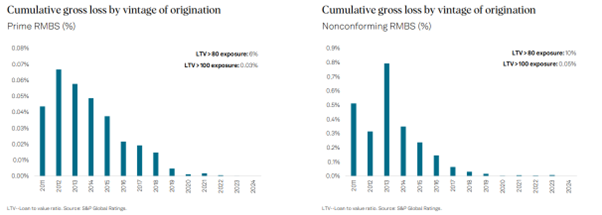
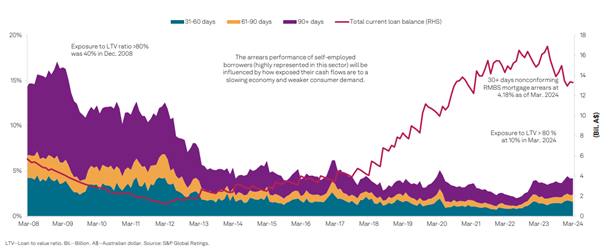
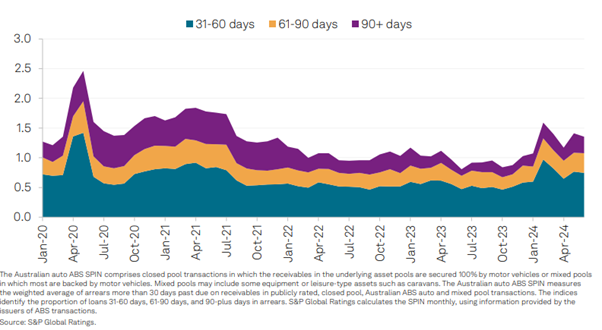
Australian RMBS has historically had a very strong performance over the past decade with property price appreciation, lower exposure to high Loan to Values (LTVs) and modest average LTV ratios across the pool of mortgages. S&P data shows that prime RMBS has only experienced almost 7bps of cumulative losses at its peak over the last 13 years while non-conforming RMBS has seen almost 80bps of cumulative losses. For prime RMBS, this is comfortably covered by the equity tranche before all the other structural protections in the RMBS.
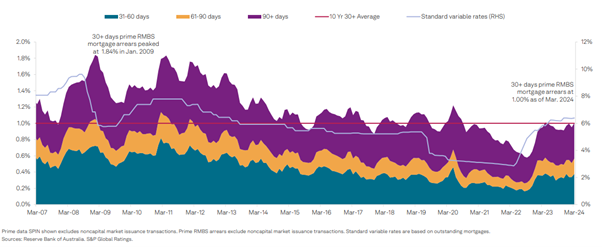
Delinquencies have generally followed the Australian interest rate environment with arrears typically rising during higher interest rate environments for mortgages. Historically, there has been a significant difference in performance between prime and non-conforming mortgages by a factor of almost 10 times.
Benefits to Portfolios
Correlations
Securitised credit can lower portfolio correlation with traditional fixed income sectors, such as corporate credit. This benefit arises from the broad diversification within the securitised market, along with the flexibility in ratings, maturities, and coupon types. Additionally, correlations are low among individual securitized subsectors, showcasing the varied opportunities and profiles within the asset class. Reduced portfolio correlation can lead to a more stable investment experience during market volatility, ultimately improving the risk-adjusted return profile in a multi-asset portfolio.
Ratings Migration
Credit ratings within corporate credit can often drift downward due to downgrades and, occasionally, defaults. In contrast, the securitised credit market frequently shows an upward trend in credit ratings. This is primarily due to the mechanics of principal payments throughout the life of a transaction, which reduce leverage at both the underlying loan and bond levels. For instance, in an auto ABS transaction, monthly principal payments from auto loans pass through the transaction and immediately amortise the bond’s principal, thereby increasing credit enhancement over time. This differs from corporate credit, where the principal remains fully outstanding until maturity.
Relative Value
While generally less liquid compared to corporate credit, skilled securitised credit research can be rewarded with complexity and liquidity premiums, offering higher yields across similarly rated securities.
| Characteristics | Unsecured Corporate | Secured ABS |
| Deal | John Deere Financial Ltd | Columbus Capital Triton 2024-2 Class C |
| Credit Rating | A | A |
| Coupon | 5.05% | ~6.3% |
| Credit Spread | 100 | 200 |
| Expected Maturity | 28/06/2029 | 17/07/2029 |
Source: Daintree
Flexibility
The securitised market provides investors with a diverse array of opportunities that have grown significantly over the past decade. This includes various types of collateral across the entire rating spectrum, from AAA to unrated securities. Such diversity offers a wide range of options in terms of rating, maturity, credit spread, and yield. Importantly, this exposure can help reduce portfolio correlation compared to traditional fixed income sectors like corporate credit.
Securitisation in Australia
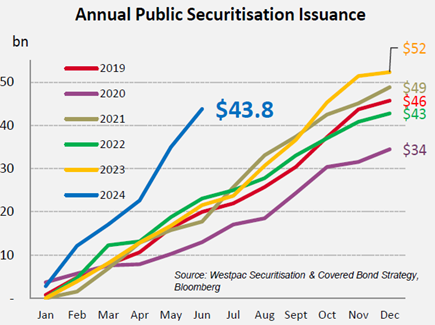
The securitisation market in Australia has grown over time and changed compositionally. The chart from Westpac shows that public securitisation in Australia has already hit almost $44bn in the 1H24 with prior year 2023 setting a record at $52bn of issuance.
Typically banks have been a large issuer of RMBS in the Australian market but the chart from Kanganews shows the higher prevalence of non-bank financials representing a much larger share of the Australian securitisation market compared to the traditional authorised deposit taking (ADI) banks in the past few years for Australian RMBS while Australian ABS has recently entirely been issued by non-bank financials who have bought the ABS loan books from the banks exiting the business.
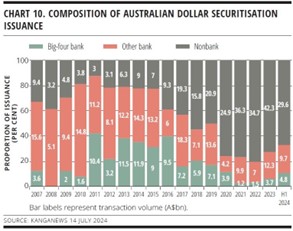
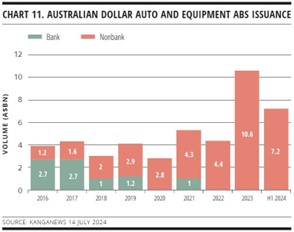
With the growth of the Australian mortgage market, non-bank financials have taken market share from the banks with competitive rates, provide different offerings and are able to service customers who do not always meet the credit standards of the banks. The trend in non-bank financial securitisation issuance is also due to their lack of balance sheet capacity to hold all these loans, so they are required to frequently issue securitised assets to offload the risk off their books and continue to write more loans.
The Australian government has also supported Australian securitisation in the past, helping smaller non-bank financials with funding via their warehouses and also providing liquidity and support through buying tranches in Australian RMBS deals during times of market turbulence. This is implemented via the Australian Office of Financial Management (AOFM) through two funds which are for investing in securitisation products – the Australian Business Securitisation Fund (ABSF) and the Structured Finance Support Fund (SFSF).
The ABSF was announced in November 2018 to support the provision of, and develop the market for, finance to lenders for small to medium enterprises (SMEs), aiming to develop the market by assisting SME lenders to establish a track record of performance, which makes these products more attractive to other investors.
The SFSF was established in March 2020 as part of the Government’s economic response to COVID‑19. The AOFM may invest up to $15 billion in securitisation products which finance mortgages and other loans to businesses and consumers. Maintaining access to finance for small lenders during the impact of COVID-19 supports competition in the lending market, helping to keep borrowing costs low for businesses and consumers.
Wrapping Up
Securitisation is a powerful financial tool that can provide significant benefits in terms of liquidity, risk management, and investment opportunities. In addition to collateral diversification, the securitised market provides varying degrees of rating, maturity, yield, and credit spread, enhancing its appeal as a diverse and growing asset class that offers investors an important means of diversification and yield in a multi-asset portfolio context.
The case can be made for security in securitisation with:
- Structural support features such as excess spread, principal redraw and liquidity facilities
- Paydown of principal over time creating increased credit enhancement and ratings upgrade
- History of low cumulative gross losses in prime and non-conforming Australian RMBS
- Risk retention of the equity tranche from the issuers to align incentives
- Support from AOFM to maintain liquidity and stability in the market
However, it also comes with inherent risks that need to be carefully managed and understood. Understanding the mechanics, benefits, and risks of securitisation is crucial for making informed investment decisions.
Disclaimer: Please note that these are the views of the author Simon Wang, Senior Credit Analyst at Daintree, and are not necessarily the views of Daintree. Some small changes were made to this article, based on updated information. This article does not take into account your investment objectives, particular needs or financial situation and has been prepared for general information purposes only and must not be construed as investment advice or as an investment recommendation.