
Investment and fashion have one thing in common – they are dominated by trends. In the same way that Birkenstocks seem to come back in to fashion every 7-10 years, credit spreads are well known as a barometer of investor psychology.
Investors are constantly adapting their investment strategy based on the prevailing environment and individual needs or goals. Over time, new and exciting themes emerge (remember the Metaverse?) which then recede, extended periods of pessimism make way for valuation bubbles to form, and there is always debate about the appropriate earnings multiple, or the yield level that could spell disaster for portfolio returns.
This same tension is present with credit spreads. Oaktree founder Howard Marks neatly sums up the proposition for credit investors in a memo published on 6 March 2025:
“Yield spreads primarily fluctuate with trends in defaults and the investor psychology regarding them. When more companies are defaulting and investors expect higher levels of defaults in the future, they’ll demand more protection in the form of wider spreads. The thoughtful investor has to evaluate that expression of opinion against what the reality is likely to be and assess whether investors are being too optimistic or too pessimistic.”
We investigate credit spreads through the lens of some of the most fundamental tenets of finance to better understand how they might perform in the months ahead.
Supply and Demand
Australian credit markets have had a busy start to 2025. Issuance of new bonds in the primary market has been evenly split between Corporate, Financial and RMBS/ABS issuers. Meanwhile, investment managers in the credit sector are seeing solid inflows.
To demonstrate this, consider a selection of recent primary deals among corporate and financial issuers. The strength of book coverage shows the demand for quality issuance, including for issuers outside of Australia issuing in the local currency, known as “kangaroo” bonds.
Clearly, with such demand, borrowers can achieve attractive funding costs and tenors that best match their funding requirements.
Table 1: Selected AUD corporate bond issuance

Source: Covalent Capital
Yield and Spread
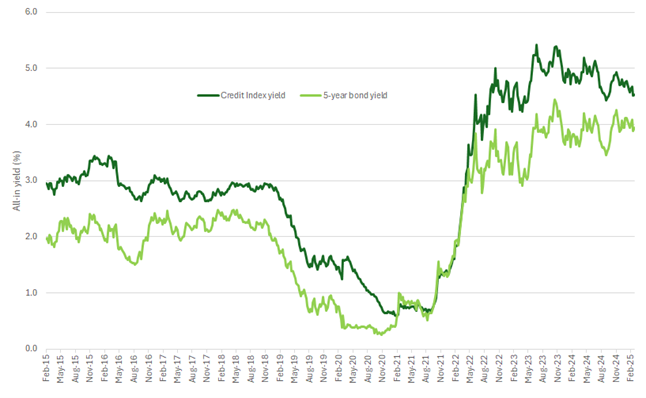
The credit spread is an important reflection of risk compensation and is additive to the prevailing “risk-free” rate, proxied by the government bond yield. But when interest rates are high to start with, corporate bonds can still look attractive relative to other assets even when spreads are tight by historical standards.
To demonstrate we can disentangle the base rate from the credit spread through time, as we have done in Figure 1.
Figure 1: Credit index* and government bond yields
Source: Bloomberg. *Credit index = Bloomberg Ausbond Credit 0-5yr
The additional spread to take credit risk has averaged about 70bp over the last 10 years, with the current premium of 62bp being tighter than, but not too far from this average. In the years post-pandemic where cheap capital was plentiful and inflation became a problem, a peculiar situation arose where credit spreads held their ground while interest rates rose sharply. Since mid-2022, a more normal relationship has been re-established.
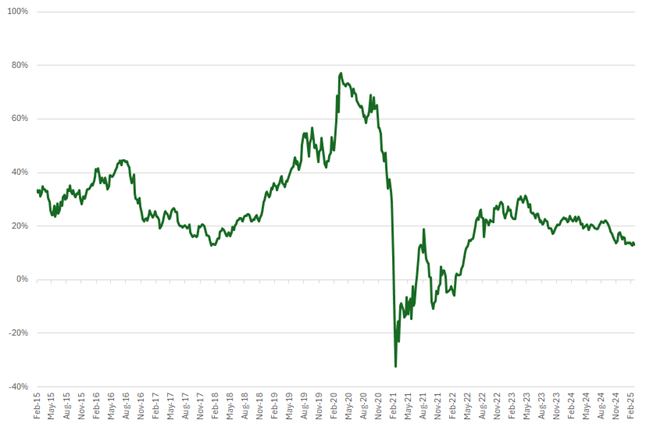
In the years pre-pandemic, the spread proportion averaged close to one third of the expected total return. Now, that figure is just 13% of the expected total return, highlighting the greater contribution of rates to the total return equation (Figure 2).
Figure 2: Spread as a proportion of credit index* expected total return
Source: Bloomberg. *Credit index = Bloomberg Ausbond Credit 0-5yr
With the contribution from spread being so low by historical standards, the worry is that credit investors are not being compensated adequately for risk. But in the above examples the credit index we reference is an investment grade offering, where expected credit losses are minimal, and the all-in yield (rates + credit spread) remains attractive relative to other assets.
Take the S&P/ASX 200 equity index as an example. At the end of February, the 12-month forward PE was 22x. The inverse of this is known as the earnings yield, currently standing at 4.55%. This is very close to the all-in yield of the Bloomberg Ausbond Credit 0-5yr index referenced in Figure 1.
To consider this from another angle, the 12-month forward dividend yield for the ASX200 is 3.7%. This is below the all-in yield of the credit index. Obviously, investing in credit provides a more stable income as the key return source, whereas shares offer a mixture of income and capital growth.
The comparisons above highlight the power of interest rates to influence investment decisions, especially when they are a larger proportion of credit returns.
Risk and Risk Adjusted Return
Spreads are tight by historical standards, but the combination of rates and spreads is still an attractive proposition relative to the underlying fundamentals. The outlook is not uniformly rosy for all sectors, but there is little concern about the creditworthiness of investment grade borrowers with manageable debt loads.
This confidence is spilling over into the opaque world of private credit, where often the underlying credit ratings are weaker than in the public markets. In addition, strong demand is allowing borrowers to secure terms that arguably underestimate the risks involved and reduce protections for the investor/lender.
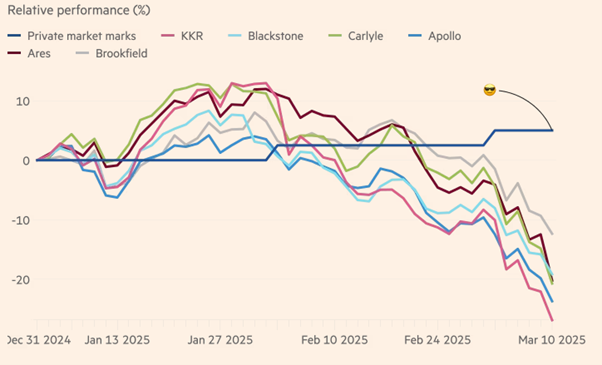
Recent market volatility has seen the share prices of the listed private credit operators hit, but the marks on the private assets in which they invest are much less likely to change in response to short-term gyrations. Even as interest rates rose sharply in 2022 and 2023, private assets demonstrated an enviable resilience.
Figure 3: Private credit managers vs private credit assets
Source: Financial Times
The concept of liquidity is difficult to quantify but essential when it is needed. For assets that trade privately, liquidity is even more of an enigma. Regular trading produces valuable market information for all participants – volumes and direction, sectoral performance, and how easy it might be to trade certain bonds and the price impact of doing so (ie: liquidity). But when public markets see private markets steady even during periods of unrest, this can send muddled signals to the public markets and possibly suppress credit spreads below their natural levels.
Ultimately, in private credit, you are placing much more faith in the investment manager because the chances of them being able to liquidate a given position is much more uncertain, even in well-functioning markets.
So, where to now for spreads?
Despite being tighter than long term averages and representing a relatively small part of overall returns, historical experience has shown that credit spreads can remain low for extended periods.
Credit spreads are not immune to acute spikes in uncertainty, but we see several technical and fundamental reasons why spreads can continue holding their gains of recent years. Investor demand, high all-in yields, and the influence of private credit all make a strong case to maintain exposure to credit markets.
If we haven’t been able to convince you, we will conclude with fellow credit investor Howard Marks’ assessment of the current environment:
“The current level of offered yields implies higher returns from credit than the S&P 500 — and with returns that are contractual and thus subject to much less variability and uncertainty. This is true despite the return contraction that has been brought on by the swing from pessimism to optimism over the past two years and even given today’s narrow spreads. Credit isn’t a giveaway today, but it offers healthy absolute returns and is fairly priced in relative terms.”
Disclaimer: Please note that these are the views of the author Brad Dunn, Senior Credit Analyst and Portfolio Manager at Daintree, and are not necessarily the views of Daintree. Some small changes were made to this article, based on updated information. This article does not take into account your investment objectives, particular needs or financial situation and has been prepared for general information purposes only and must not be construed as investment advice or as an investment recommendation.