
In this note we will explore how to build portfolio defensiveness, a topic of particular saliency when set against the present backdrop of shifting geopolitical and economic relationships, and elevated asset prices.
Why Play Defence?
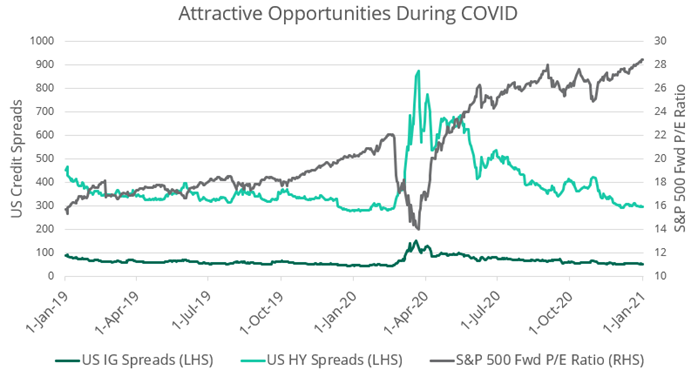
Whilst some investment approaches feature a multi-generational timeframe on investment returns that can weather occasional severe drawdowns, for most of us such drawdowns can have a very tangible impact on our lives. This “sequencing risk” might impact your ability to buy a house, pay for your children’s education, or enjoy the retirement that you were expecting. Conversely, lingering fear of such an outcome may lead to suboptimal investment decisions – not holding enough in growth assets in the first place, or (worse) cashing out at the depths of a drawdown event. A good defensive strategy should help ameliorate both the actual risk of portfolio drawdowns, as well as providing peace of mind, hopefully supporting sound investment decisions. Ideally it should also provide liquidity to purchase growth assets during a drawdown, when they are unusually cheap.
Source: Daintree, Bloomberg
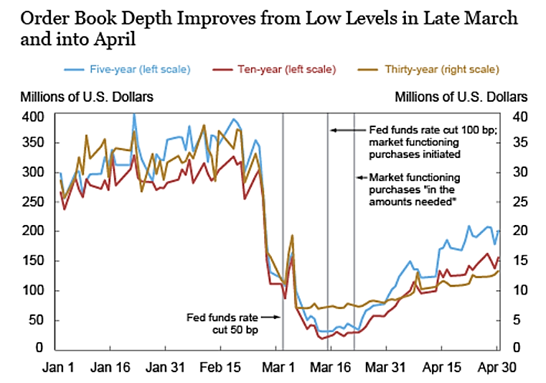
Diversification is generally the cornerstone of portfolio construction. However, diversification can only do so much for you in a true systemic dislocation event, when there are forced sales in any venue that offers liquidity. Asset prices can become untethered from their fundamental values, and cross-asset correlations may tend towards 100%. What is required at such times is an asset or strategy that reliably provides strong returns, as well as offering the necessary liquidity. Portfolio defence which cannot be readily monetised in times of crisis offers no security at all. For example, whilst other factors were at play, the dearth of US Treasury depth during at the COVID nadir was shocking.
Source: Liberty Street Economics, New York Fed / BrokerTec
Further to this – fiscal, regulatory, and monetary support has instilled reliance on intrinsic free “puts”, leading to compressed risk premia. Conversely, governmental and central bank balance sheets have expanded to a point that such support cannot be counted on in the future. Liquidity across asset classes is increasingly driven by algorithmic and passive agents, producing air pockets at times of distress. Market structure, incorporating these themes, has become more sensitive to shocks and event risk. In August 2024, as the yen carry trade unwound, a less-than-10% drop in the S&P 500 was associated with a more-than-52 point rise in the VIX, a huge risk-off move relative to the size of the equity drawdown. This fragility is likely to remain a feature until (perhaps) we suffer a full reset in market structure and asset prices.
Duration?
Duration has been the go-to solution for building portfolio defence since the 1990s, which saw the entrenchment of the “Fed Put”, following monetary support during the 1987 crash and in subsequent crises. The multi-decade bull market in bonds didn’t hurt either, as inflation was supposedly tamed by modern central bank approaches. This was the golden age of the 60:40 portfolio and its variations, predicated on bonds and equities exhibiting negative correlation, especially during dislocation events. However, prior to the last thirty years equity / bond correlation tended to be positive, especially during times of higher inflation. Duration’s efficacy as a defence strategy, in recent decades, is an historical aberration. Indeed, during the depths of COVID bonds and equities tanked together, and after the rate shock of 2021/2022 the correlation regime has shifted towards historical norms.
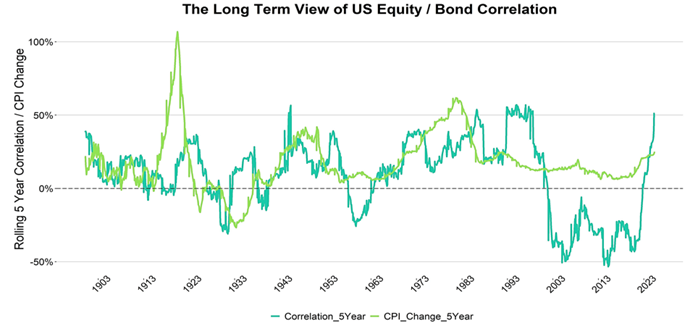
Shows: Rolling 5-year correlation of the S&P 500 to US Treasuries versus rolling 5-year change in CPI
Source: Daintree, Bloomberg, Robert Shiller
Put Options
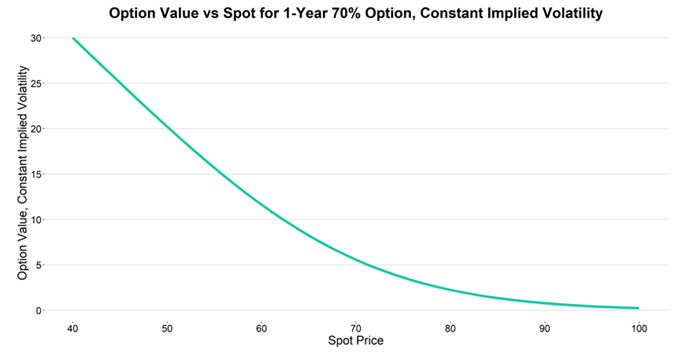
Put options, on the other hand, provide a unique hedging instrument that contractually rises in value as the underlying asset drops, and where returns actually accelerate the larger and faster is the drawdown, exactly the conditions we are looking to hedge against. This “convexity” is highly desirable when building portfolio defence.
Source: Daintree
Not only do put options benefit from a drop in the underlying asset price, but also from any increase in volatility. The “implied volatility” of an option measures the market’s expectation of future volatility for the underlying asset and will typically rise as the asset trades with larger swings. As an example, if you were lucky enough to buy the S&P 500 December 2020 put, with a strike of 1925, at the start of Feb 2020, you made 25 times your money at the market depths. Strikingly, nearly half of that profit came from the increase in implied volatility.
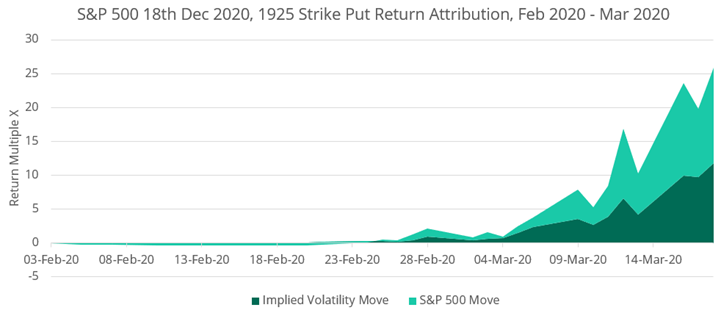
Source: Daintree, OptionMetrics, Bloomberg
Defence Plus Income
At Daintree Capital we use options across a range of asset classes to build defence in our portfolios. We especially like using equity puts to hedge dislocation or “tail” risks. This is because equity puts, particularly on benchmark indices such as the S&P 500, offer deep and liquid markets that remain functional even during dislocation events (albeit bid / ask spreads may be wider), which is a primary consideration when building a defensive strategy.
Further to this, we would generally expect substantial drawdowns in credit to coincide with dislocations in equities. Equity drawdowns tend to be relatively larger in scale, and faster moving, than credit, providing greater convexity as a hedging venue. Equity puts are therefore incorporated across all our portfolios, as a tail hedge against the core credit exposures. Holding such a tail hedge allows us to be more confident in maintaining target exposures during times of rising stress; and provides a liquidity mechanism during dislocations, which can then be reinvested in assets when they are attractively priced.
In one of our strategies, Defensive Plus, the tail hedge is scaled up substantially. This is done with a view to providing convexity during dislocation events, at the headline fund level, whilst still generating a net-of-fees return above cash in the interim (“defence plus income”). Recent results speak to the efficacy of this approach, given steady returns and excess profits during market pullbacks.
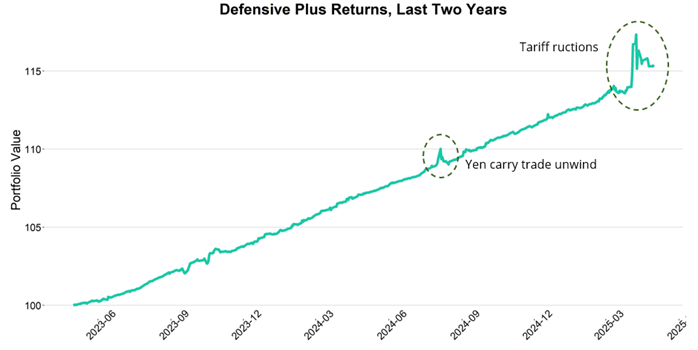
Shows: Gross Total Returns to Defensive Plus.
Source: Daintree, Bloomberg
The tariff ructions in April of this year provided a good case study as to how such a strategy might perform during a substantial pullback. Defensive Plus was up 3% at the depths, and another 1% more than this intraday. The returns to the tail hedge meaningfully outweighed any drawdown on the credit portfolio. If markets had dropped another 10% from those levels we conservatively expected at least a further 3% of profits. Because the defensive strategy is built from options that derive their value from market moves, we can state these figures with some confidence. The value of having a predictable hedge at such times cannot be understated.
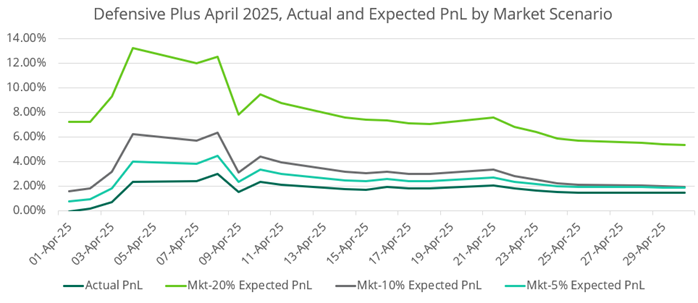
Shows: actual April 2025 returns, net of fees, with a conservative estimate of further gains had the market continued falling by 5%, 10%, or 20%.
Source: Daintree
Building Portfolio Defence
Given the predictable defensiveness and liquidity of an equity tail hedge strategy, compared to the potential uncertainty of relying on duration or other defensive strategies (a topic for a future note), a strategy like Defensive Plus is a valuable one to have in the portfolio construction toolbox.
In fact, since COVID and the regime shift in rates in 2021/2022, replacing duration in a 60:40 portfolio with Defensive Plus has shown substantial outperformance. Given the market structure, the stresses to the postwar economic order and the fiscal hangover that is likely to come, and question marks over the exceptionalism enjoyed by the US government, there is every reason to believe that this outperformance may persist. Building portfolio defence via options does not rely on any institutional or market behaviour assumptions, only that the underlying assets will drop substantially in a true dislocation event. That seems like a pretty safe bet in such uncertain times.
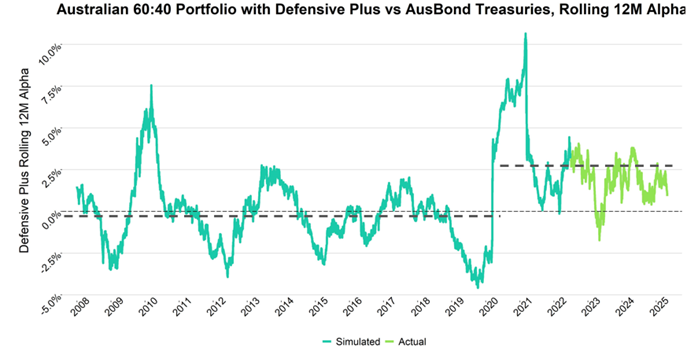
Shows: Alpha to a 60:40 portfolio holding ASX 300 (60%) with Defensive Plus (40%) vs a 60:40 portfolio with Bloomberg AusBond Treasuries 0+, Gross of fees.
Source: Daintree, Bloomberg, OptionMetrics
Disclaimer: Please note that these are the views of the author Michael Pollard, Portfolio Manager of the Daintree Defensive Plus Trust, and are not necessarily the views of Daintree. Some small changes were made to this article, based on updated information. This article does not take into account your investment objectives, particular needs or financial situation and has been prepared for general information purposes only and must not be construed as investment advice or as an investment recommendation.