
It has been tough for sovereign duration investors in the years since the pandemic, and we don’t think things get any easier from here. The emergence of inflation caused by supply chain disruption and massive fiscal spending saw interest rates rise in response. However, governments globally remain on a high spending path, preferring fiscal profligacy for electoral or political benefit. Without a credible plan to balance national budgets, global bond investors, already smarting from several years of poor performance, are increasingly selective about the quantum and type of duration they hold. We think all investors should take notice, because developments at the long end of the yield curve can have huge implications for the continued smooth functioning of one of the most important markets in global finance.
Duration drag
In most major world markets, long-term interest rates are close to their highest levels in more than 20 years. In our view, the steepening of yield curves is reflecting a growing unease with the health of state finances amid a broader cultural shift away from fiscal responsibility.
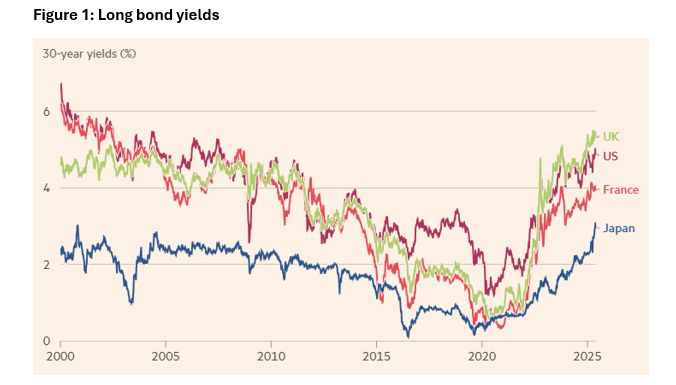
Source: Financial times
For an investor contemplating a commitment as long as 30 years, the viability of government finances is a key consideration. But the longer that funding costs remain high (and hold the prospect of going higher), the greater the risk that private capital is crowded out, productivity is restrained, and debt servicing costs become a drag on economic output.
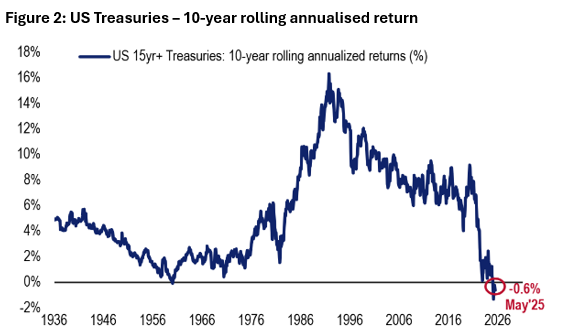
Not to mention, these challenges are facing investors off the back of poor investment returns for long duration assets since the pandemic. Indeed, on a rolling 10-year basis for 15+yr US Treasuries, the annual return equates to -0.6% per annum – only the second time this metric has gone negative in the last 100 years.
Source: Bank of America, GFD, Bloomberg
Figure 2 also provides some evidence of multidecadal trends, underscoring the point that any recovery is unlikely to come quickly. For example, the drastic measures needed in the 1970s to address inflation driven by runaway oil prices did not manifest into solid annual returns until those investors were able to collect these elevated coupons for years afterwards. In a similar vein, the poor returns today are partly a relic of the low-interest-rate period post-GFC, combined with lags created by duration in a rising rate environment.
Fiscal and monetary challenges ahead
Government bonds are often referred to as “risk-free” assets, but this usually refers to coupon payments and (nominal) capital returns. For bonds with longer maturity dates, there are many other risks to consider when committing capital on a generational timescale.
The primary risk is duration, the effects of which can be amplified by supply and demand dynamics. For example, a recent poor 20-year Japanese government bond (JGB) auction led to rising yields across the longer end of the JGB yield curve.
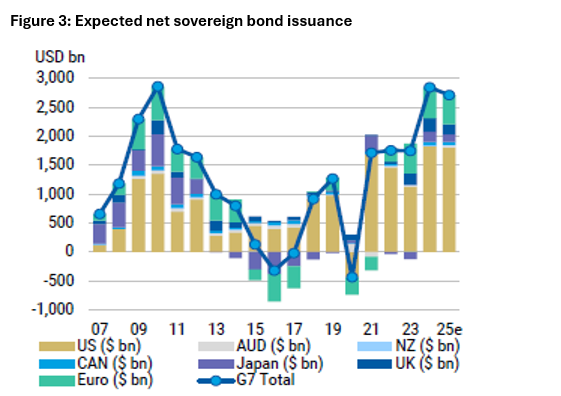
It is not just Japan that has a fiscal deficit to fund. The entire G7 will require just short of $3tn in net new issuance just this year, equating to the third biggest issuance year since 2007.
For us the question is – will there be sufficient demand to absorb all this supply?
Source: National treasuries, Morgan Stanley estimates
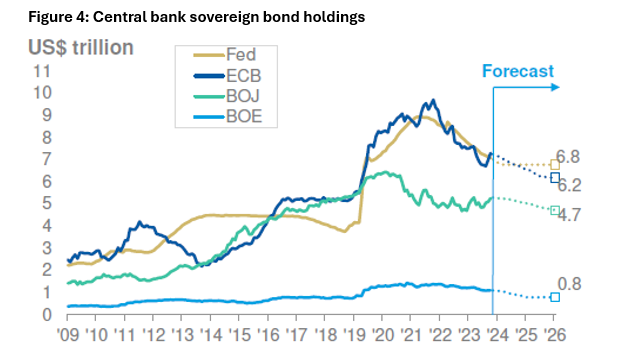
To compound the problem, governments are likely not the only offerors, with major central banks at varying stages of normalising their balance sheets by gradually selling their holdings of sovereign bonds.
Source: Morgan Stanley, Bloomberg
So who is buying? With falling inflation and higher rates, the real return on a US long bond is the highest it has been in 16 years. But with persistent political and trade uncertainty, the inducement to lock up capital for as long as a generation may need to rise further before it attracts enough capital to stabilise the real return. Indeed, US 30-year real rates were above four percent in the late 1990s.
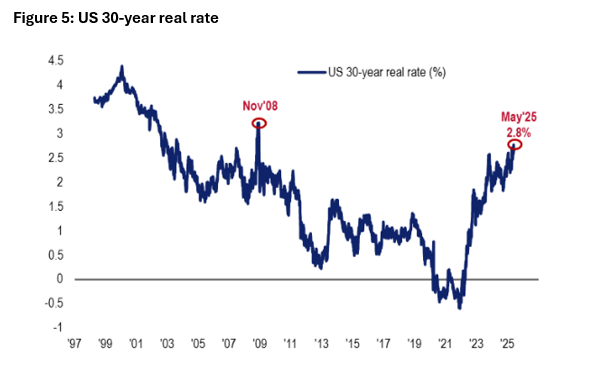
Source: Bank of America, Bloomberg
Investment implications
For fixed income funds and investors, one important decision is the “how much” and “what type” of duration exposure. Local investors have a growing choice of active and passive options, many of which are accessible in listed format.
In the context of this article, the funds with higher risk of performance challenges are those managed in a passive manner that are benchmarked to indices with higher levels of duration. It is these funds that have been struggling in recent quarters. Indeed, in the first quarter of 2025 US-based funds saw their largest outflows in five years (see Figure 6).
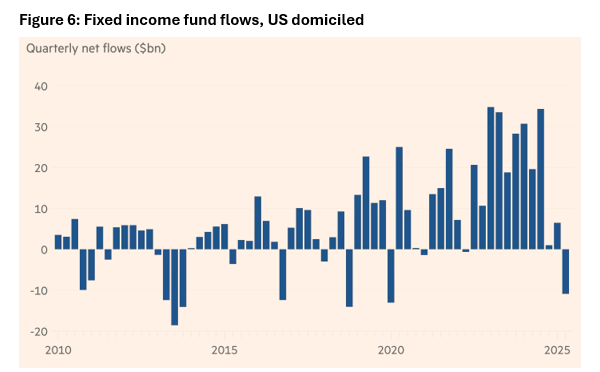
Source: EPFR, Financial Times
Trade uncertainties and heavy spending governments are likely to keep inflation expectations elevated. In this scenario, term premium will remain in demand even if central banks decide to continue their easing cycle.
From an investment perspective, you can express this view by considering a wider range of potential solutions, emphasising low duration, high quality (ie: investment grade) constituents, with a focus on corporate lending rather than as a sovereign creditor.
In our view, while the concept of a risk-free asset being proxied by a government bond still holds, the nuance we would add is they are no longer the asset first relied on to nullify volatility from riskier assets such as shares.
To be clear, we believe that the default of a developed market sovereign issuer is extremely remote. But in an environment of major uncertainty about the right level of yield for a large and growing amount of government liabilities, we expect long bonds to be a less reliable shock absorber for investment returns.
Table 1 tries to relate the impact of duration to the expected annual return of a group of fixed income funds listed on the ASX. The key takeaway from this table is that for a given yield to maturity (YTM), a 100bp move upwards in yield can consume more than a year’s worth of return if duration is not managed appropriately, introducing unnecessary noise into a portfolio from a source that is meant to be providing relative stability.
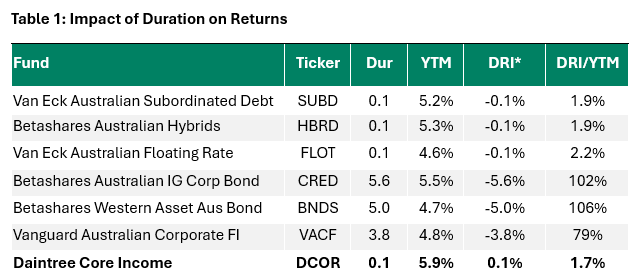
Source: ASX, Daintree. *DRI = Duration Return Impact, reflects the performance impact of a 100bp increase in yields.
For the funds in Table 1 with lower interest rate duration, the primary risk driver is credit spread duration. When comparing DCOR to the other low duration tickers, DCOR is a fully diversified actively managed portfolio, while the others are either benchmark aware and/or generally focussed on a single type of fixed income security.
DCOR is designed to harvest the credit spread while actively managing duration risk. As at 30 June, the fund held 246 unique issuers representing 517 securities, with a weighted average credit rating of A-. By being able to control the temporal influence of what is arguably the most unstable metric right now, we can seek to achieve the optimal balance of return and risk exposure today.
Disclaimer: Please note that these are the views of the author Brad Dunn, Senior Credit Analyst and Portfolio Manager at Daintree, and are not necessarily the views of Daintree. Some small changes were made to this article, based on updated information. This article does not take into account your investment objectives, particular needs or financial situation and has been prepared for general information purposes only and must not be construed as investment advice or as an investment recommendation.