
New highs! AI bubble! Lines to buy gold!
It can all be so distracting. There is a lot of noise being created in markets, but underneath the talk of technology super cycles, most asset classes are delivering solid results this year.
Globally, central banks have cut interest rates 270 times in the year-to-date, leading to equity market cap gains exceeding US$20trn, and credit spreads that are at or through cycle lows.
Through this lens, we take a closer look at the recent performance of the Daintree Core Income Trust, and how we can best respond to shifting market conditions to build on recent results.
Unit price at all-time highs
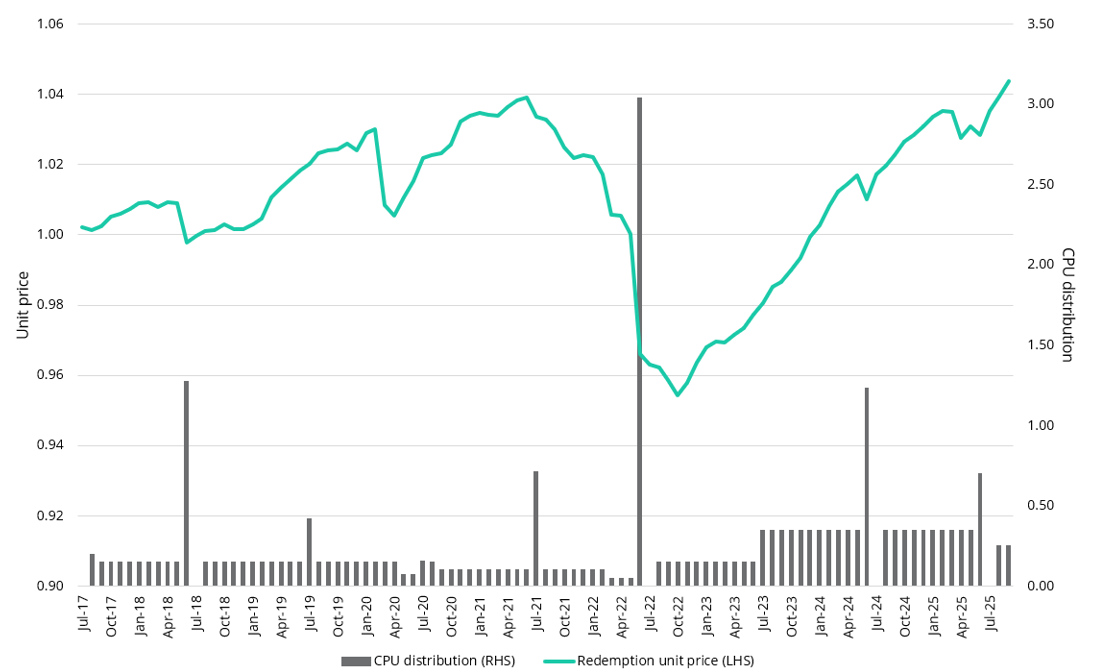
Daintree unit prices display just a fraction of the daily movement compared to a share portfolio, but they can directionally trend in certain conditions. Indeed, our Core Income portfolio has recently hit a new record high only three years after posting record lows.
Figure 1: Daintree Core Income unit price
Source: Daintree. Data as at 30 September 2025.
Because Daintree typically has low portfolio turnover, the unit price essentially reflects the value of assets held by the trust, which includes a proportion of unrealised capital gains.
With a neutral duration position in effect for much of the last two years, the core driver of any capital gains has been tighter credit spreads.
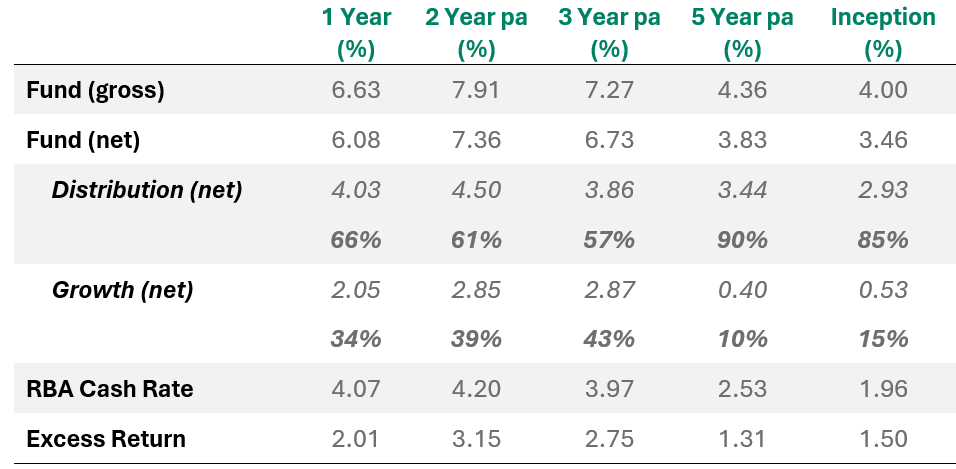
As a result, over the last two years, the performance split between growth and distribution has considerably narrowed. Growth has represented 39% of total return, compared to 15% since the inception of Core Income in July 2017.
Table 1: Core Income performance split
Source: Daintree. Data as at 30 September 2025.
This presents somewhat of a dilemma, because these capital gains are, by definition, temporary. Daintree’s core investment philosophy revolves around capital preservation and maximising risk-relative return, and there are several reasons why crystallising capital gains has less appeal.
The first issue is tax. Most investors in the fund (we would hope) are primarily seeking an income from their investment. While tax considerations will vary considerably based on several factors, having a high degree of taxable return in the form of capital gains may not align with the typical investor in a fund such as Core Income.
A second problem is cash drag. By selling assets for capital gain, we increase cash and forego the credit premium. The credit spread is an important part of the fund’s total return equation, so being unnecessarily long cash will drag on performance over time.
A related problem is reinvestment risk. If the assets we sell have tight credit spreads, any replacement assets of a similar tenor and quality will also likely have tight spreads. Therefore, to increase portfolio yields in this market, we may need to compromise on credit quality or accept longer credit spread duration.
Volatility at the Sharpe end of the spectrum
As the unit price has been rising to new heights, the annualised volatility of the fund has fallen to about half of that recorded since inception. In other words, performance has tended to show reduced levels of periodic variation.
While shrewd asset allocation played some role in this (if we do say so ourselves), the primary driver has been the market beta, or simply being in the market.
Consequently, the Sharpe ratio (return per unit of risk) for the fund over the last two years has risen to some of the highest levels since inception. At 3.7x, this demonstrates solid progress against our goal of maximising risk-adjusted returns in most market conditions.
All shoulders to the wheel
Usually, a strongly positive Sharpe ratio is driven by one or two outstanding investments that significantly outperform the benchmark or deliver idiosyncratically large returns relative to the investment objective and risk profile.
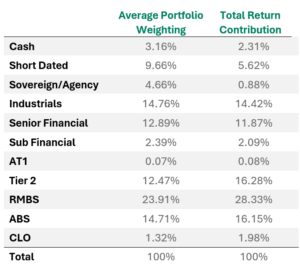
Daintree Core Income does not have that problem. Across the multiple sub-sectors in which the fund invests, average portfolio weighting since January 2024 has been a good predictor of total return contribution.
To achieve our investment objective, we prefer hundreds of reliable performers rather than relying on a handful of shooting stars.
Some sectors (Cash, Short Dated, Sovereign/Agency) will understandably underperform as they would have lower credit spreads compared to other securities. However, their value lies in being more readily converted to cash at short notice, if needed, in most market environments.
Table 2: Core Income Sector Attribution, Jan 2024 – Sep 2025
Source: Daintree. Data as at 30 September 2025.
While the music’s playing…
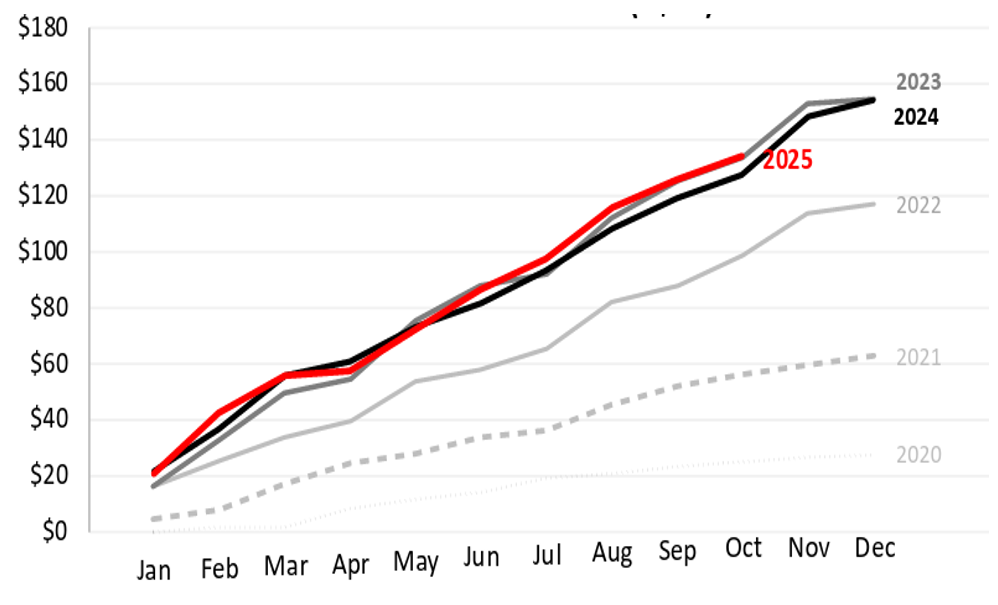
Australian debt capital markets are closing in on their third year of robust activity. The 2025 gross issuance run rate is 35% higher than 2022, and at a similar year-to-date pace as both 2023 and 2024.
One of the themes driving this momentum is a growing non-bank financial sector, where structured credit issuance is a key funding source.
Growing interest from a wider investor base has also provided a meaningful tailwind. Locally, this has been spearheaded by private banks, wealth managers, and high net worth investors. Also, more Asian investors view Australian credit as a viable alternative in the Asia Pacific region, having reached critical mass from a size and liquidity perspective.
Figure 2: Australian DCM Issuance (A$bn)
Source: Bloomberg, NAB. Data as at 17 October 2025.
Where to from here?
If current conditions persist, and credit spreads can hold their levels, we expect the unit price to level out. A relative lack of mispriced or underpriced assets means that the prospect of further capital gains is slim, while the search for optimal relative value takes on even greater importance.
Performance will also be reliant on consideration of relative value at the sectoral level, even if, as we’ve shown, those benefits are modest over time. There will always be a trade-off between maximising exposure to the strongest sub-sector and minimising risk when the cycle turns.
Maintaining current Sharpe ratios will be challenging, but with cash rates potentially falling a little further in the months ahead this will create a small tailwind as floating rates progressively adjust.
Finally, the overall size of the market continues to grow due to the maturation of the local credit ecosystem and interest from a wider investor base. New deal structures, lengthening tenors, and more issuers (including offshore issuers in AUD) provide more ways to identify alpha for our clients.
Disclaimer: Please note that these are the views of the author Brad Dunn, Senior Credit Analyst and Portfolio Manager at Daintree, and are not necessarily the views of Daintree. Some small changes were made to this article, based on updated information. This article does not take into account your investment objectives, particular needs or financial situation and has been prepared for general information purposes only and must not be construed as investment advice or as an investment recommendation.